

 +31
+31 Euro
euro · In circulation in 36 countries and territories
- ISO code
- EUR
- Symbol
- €
- Minor unit
- 100
- Notes
- 7
- Issued by
- European Central Bank
Notes and coins in circulation
- €5
- €10
- €20
- €50
- €100
- €200
- €500
The Euro’s largest current denomination is €500, worth about $573.55: the 5th most valuable top note among the 150 circulating currencies we have verified, where the median is $27.18.
ATM commonly dispensed by cash machines
Bars are scaled to face value on a log scale, not to physical size. Colours are the issuer’s own. Converted at mid-market reference rates; what a counter pays is always less.
Europa series (second series)
| Notes | Colour | Size (mm) |
|---|---|---|
| €5 | grey | 120 × 62 |
| €10 | red | 127 × 67 |
| €20 | blue | 133 × 72 |
| €50 | orange | 140 × 77 |
| €100 | green | 147 × 82 |
| €200 | yellow | 153 × 82 |
First series
| Notes | Colour | Size (mm) |
|---|---|---|
| €500 | purple | 160 × 82 |
- €500: The ECB stopped issuing the 500 euro note, so it does not appear in the Europa series. Existing notes were not withdrawn.
Getting cash
Euro area cash machines typically dispense 20 and 50 euro notes. Large denominations are often refused by small retailers.
What it is worth
| Currency | 1 EUR = | 1 unit = |
|---|---|---|
| USD | 1.1471 USD | 0.87 EUR |
| GBP | 0.8577 GBP | 1.17 EUR |
| INR | 109.9768 INR | 0.01 EUR |
Mid-market reference rates, snapshot 22 September 2026: indicative only. What you actually receive is always less. Work out the real cost →
Where it is used
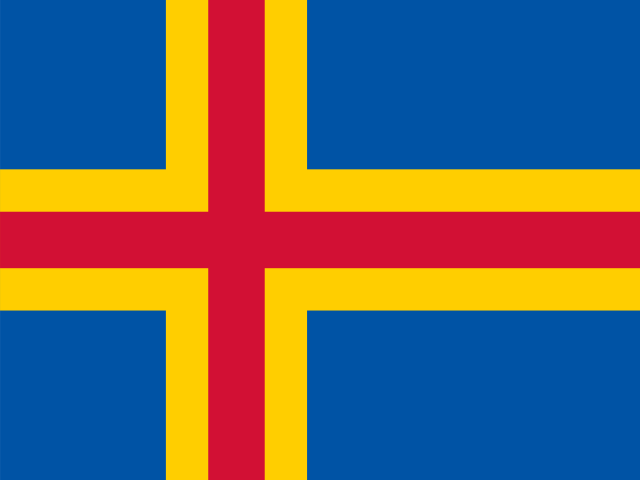
- Åland Islands
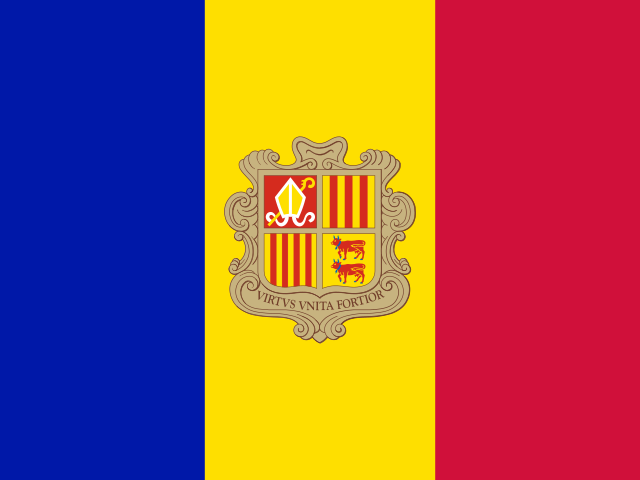
- Andorra
- Austria
- Belgium
- Bulgaria
-
 Croatia
 -
 Cyprus
 -
 Estonia
 -
 Finland
 -
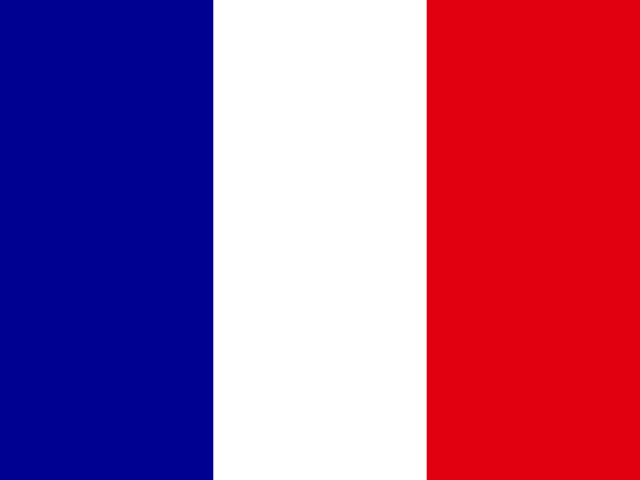 France
 -
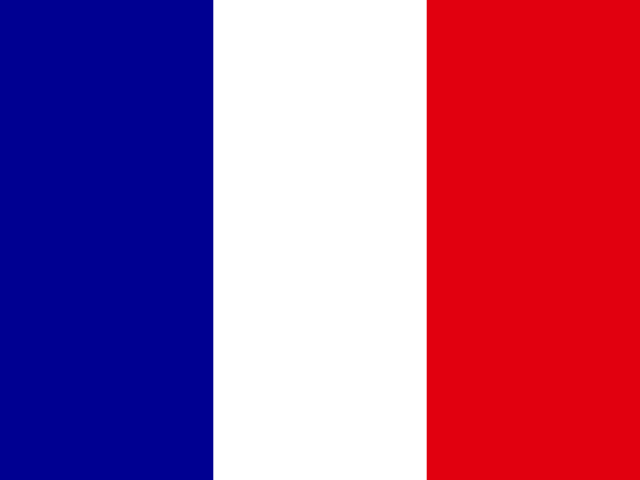 French Guiana
 -
 French Southern Territories
 -
 Germany
 -
 Greece
 -
 Guadeloupe
 -
 Vatican City
 -
 Ireland
 -
 Italy
Italy -
 Latvia
 -
 Lithuania
 -
 Luxembourg
 -
 Malta
Malta -
 Martinique
 -
 Mayotte
 -
 Monaco
 -
 Montenegro
 -
 Netherlands
 -
 Portugal
 -
 Réunion
 -
 Saint Barthélemy
 -
 Saint Martin (French part)
 -
 Saint Pierre and Miquelon
 -
 San Marino
 -
 Slovakia
 -
 Slovenia
 -
 Spain
Spain
One currency across several jurisdictions: notes issued in one are normally accepted throughout, though local issuers and designs can differ.
Practical guides
Taking cash in and out of Austria →
Declaration thresholds, the form to file, and the penalty for not declaring.
Taking cash in and out of Belgium →
Declaration thresholds, the form to file, and the penalty for not declaring.
Taking cash in and out of Bulgaria →
Declaration thresholds, the form to file, and the penalty for not declaring.
Taking cash in and out of Cyprus →
Declaration thresholds, the form to file, and the penalty for not declaring.
Torn or damaged money in Austria →
How much of a note must survive, who redeems it, and what it costs.
Torn or damaged money in Belgium →
How much of a note must survive, who redeems it, and what it costs.
Related currencies
- Austrian schilling (replaced by the euro)
- Belgian franc (replaced by the euro)
- Cypriot pound (replaced by the euro)
- German mark (replaced by the euro)
Tools
What exchanging costs →
Paste the rate you were quoted and see the gap against mid-market.
Do I need to declare it? →
Both legs of any route: where you leave and where you arrive.
Is a torn note still valid? →
How much must survive, and who pays out.
How big is a Euro note? →
Drawn to scale against a bank card, and against any other currency.
One-page cash sheet →
Notes, border limits and damaged-note rules, on a page you can fold.
Sources: last verified 22 September 2026 secondary sourced
- Banknotes: European Central Bank · retrieved 22 September 2026 primary
- Euro banknotes (Wikipedia) · retrieved 22 September 2026 secondary
- Banknotes of the euro (Wikipedia) · retrieved 22 September 2026 secondary